
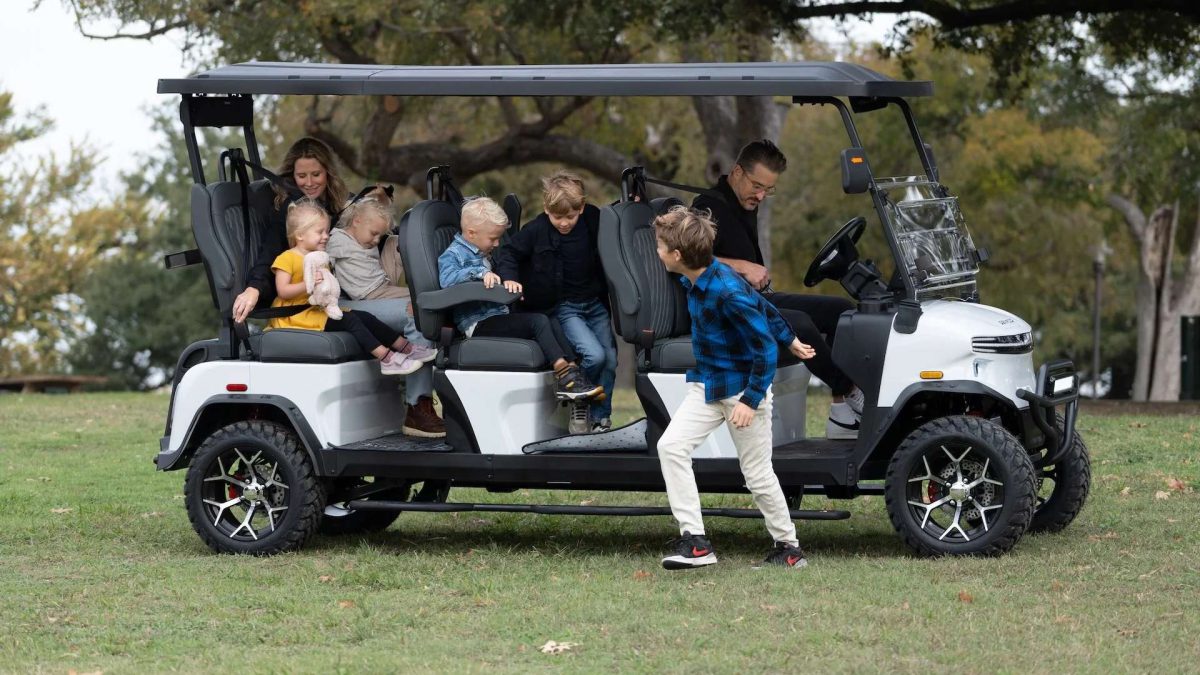
“We have two kids, a dog, and my parents visit every other weekend. Do I need four seats or six?”
I hear some version of this question almost every week. I’m Jacob, a product specialist at Denago EV Canada, and the Rover XL versus Rover XL 6 decision is one of the most common conversations I have with Canadian families.
Both carts share the same DNA: LiFePO4 lithium battery, 10-inch touchscreen with Apple CarPlay, four-wheel hydraulic disc brakes, full LED lighting, backup camera, aluminum frame. The difference comes down to seats, range, and how you plan to use it.
Let me break it down so you can make the right call for your family.
The Core Differences
The Rover XL seats four people, all forward-facing. It delivers up to 40 miles of range on a single charge and tips the scales as our most popular model.
The Rover XL 6 adds a rear bench to seat six. The extra passengers and structural support reduce range to about 32 miles, but the cart handles a impressive 992-pound combined load capacity.
Both models charge fully in roughly five hours. Both have the same 25 mph top speed, the same tilt steering, the same hydraulic brakes. The feature gap is narrow. The use-case gap is where things get interesting.
When Four Seats Are Enough

For most families, the Rover XL hits the sweet spot. Here’s why.
A family of four with occasional extra passengers fits comfortably. Two parents up front, two kids in the back. The forward-facing seats mean everyone gets the same comfortable ride, and the rear cargo deck handles bags, groceries, or gear.
The 40-mile range matters more than people expect. At a cottage or in a community, you might make five or six trips in a day. Going to the dock, coming back, heading to the neighbour’s, running to the community store, back to the cabin. Each trip is short, but they add up. The extra 8 miles of range compared to the XL 6 gives you breathing room.
Parking and maneuvering is easier with the shorter wheelbase too. If your garage or storage area is tight, the four-seat model fits where the six-seat might not.
When Six Seats Make Sense

The Rover XL 6 earns its keep when you regularly move more than four people. Here are the scenarios I see most often:
Large families. Three or four kids plus parents. The six-seat configuration means everyone rides together instead of splitting into two trips.
Cottage entertainers. If your cottage is the gathering spot for extended family and friends, six seats means you can shuttle the whole group to the dock, the trailhead, or the neighbour’s bonfire without leaving anyone behind.
Community shuttle use. HOAs and community managers love the XL 6 for guest transport, event logistics, and moving volunteers around the property.
Retirement communities. Social outings with friends, trips to the clubhouse, group excursions to community events. Six seats means nobody gets left out.
Range and Battery Considerations
The range difference, 40 miles versus 32 miles, comes down to physics. The Rover XL 6 carries more weight (the extra seats plus more passengers), which draws more from the battery.
For context, 32 miles is still a lot of driving within a community or cottage property. If your typical day involves short trips totalling 10 to 15 miles, either model will get you through with plenty to spare.
Both batteries use the same LiFePO4 chemistry, which means the same 8-year battery warranty, the same maintenance-free operation, and the same cold-weather resilience.
Maneuverability and Storage
The Rover XL is about 18 inches shorter than the XL 6. That doesn’t sound like much, but it matters in three situations:
- Garage storage. If you’re sharing garage space with a car, the shorter length gives you more flexibility.
- Tight trails. Cottage properties with narrow paths between trees or buildings are easier to maneuver with the four-seat model.
- Dock approaches. Reversing into a tight dock space is simpler with a shorter wheelbase, even with the backup camera.
That said, the Rover XL 6 isn’t unwieldy. The same hydraulic brakes, the same steering geometry. It’s just a bit longer.
The Price Question
I can’t publish specific pricing because it varies by dealer and current promotions, but I can tell you that the Rover XL 6 carries a moderate premium over the XL. For families on the fence, here’s how I frame it:
If you’ll use the extra seats at least twice a month, the premium is worth it. If you’re buying a cart primarily for a family of four and the extra seats would sit empty most of the time, save the money and go with the XL.
A Quick Decision Framework
Ask yourself these three questions:
How many people will ride together on a typical trip? Four or fewer: Rover XL. Five or six regularly: Rover XL 6.
How important is maximum range? If your property is large or you make many trips per day, the XL’s 40-mile range gives you a safety margin.
Will you use it for community or group events? If yes, the XL 6’s extra capacity pays for itself in convenience.
Both models share the same 5-hour charge time, the same all-aluminum rust-proof frame, the same full LED package, and the same CarPlay integration. You’re choosing between capacity and range, not between quality levels.
Still Not Sure?
The best way to decide is to see both models in person. Contact our team and we’ll connect you with an authorized Denago dealer in your area. You can sit in both, feel the difference, and talk through your specific needs with someone who knows the Canadian market.
You can also explore both models on our site: the Rover XL and Rover XL 6.
About Jacob — Denago EV Canada
Jacob is a product specialist at Denago EV Canada, based in North York, Toronto. With years of hands-on experience in the electric vehicle space, he helps Canadian families, communities, and businesses find the right lithium-powered cart for their needs. When he’s not writing about LiFePO4 batteries and community mobility, you’ll find him testing the latest Denago models around Ontario’s cottage country.
